Staffing - AI, Work, and the Care Sector Opportunity We Might Be Missing
AI, Work, and the Care Sector Opportunity We Might Be Missing
The care sector has a once-in-a-generation opportunity. Are we going to take it?
AI can help us but not in the way we all may first think!!
I've thought about this for a while now, mainly because the more I look at what is happening across the wider economy, the more I think social care is staring at a genuine opportunity. Not a vague “we should do better” opportunity, but a proper chance to attract new people into the sector, change how care is seen, and build a stronger workforce for the future.
Two problems that should be connected
For me, I now see two things happening at exactly the same time: more people looking for meaningful, stable work, and a care sector that still faces a chronic workforce shortage.
Those two lines are going off on their own paths right now, yet somehow we still do not seem to bring them together to properly connect the dots in between. The question is whether we are actually going to take it, or whether, as a sector, we’ll do what we sometimes do far too well and get in our own way.
Cutting through the AI waffle!
We are all hearing the constant chat around AI at the moment. Every conference, every business article, every LinkedIn post seems to mention it. Half of those posts, rather ironically, have clearly been written by AI themselves, and you can usually spot them a mile off. Overly polished, bland, slightly soulless and in a language most people do not use. In English, of course, but not the tone or phrases everyday conversations are written or spoken in. It turns me off reading most of it, to be honest.
If we forget all the AI gossip and waffle for a minute, because there is a real point…
Jobs are changing quickly. Entry-level office roles are being reduced. Admin jobs, data entry, junior sales roles, call centre positions. The sort of roles that have traditionally given school leavers and young people their first step into work are being automated at pace. For many people entering the workforce now, options are dwindling by the day.
AI is changing the way we work in every setting and reducing the number of people we need in many different ways. From clerical and administrative roles to even more complex and once-deemed highly skilled white-collar careers, these career paths are no longer a good long-term opportunity for those embarking on their career journey.
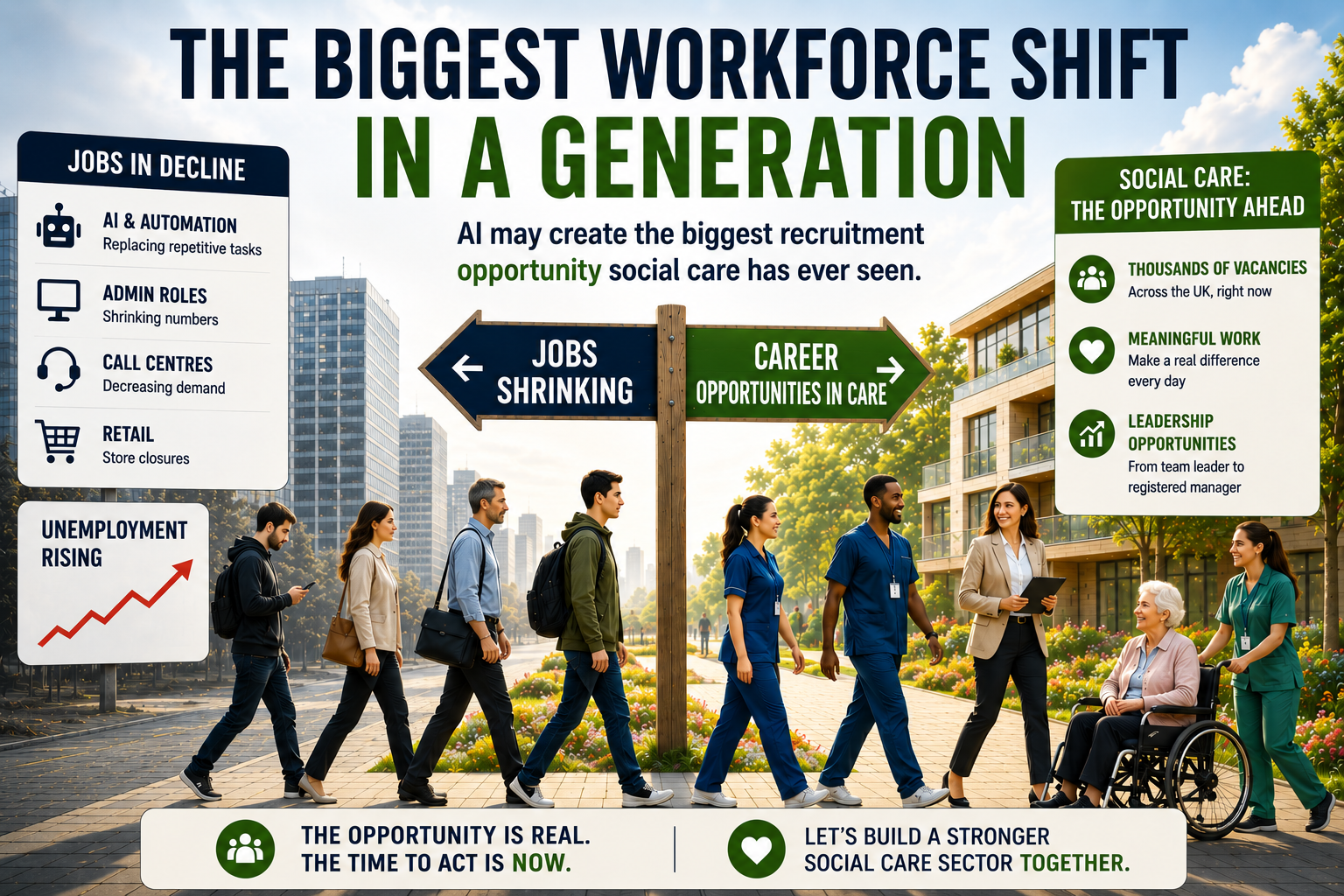
At the same time, the overseas worker pipeline that helped keep care staffing afloat has tightened significantly. The sector had become heavily reliant on it. Quietly, conveniently, and in some cases far too comfortably.
The human work still matters
I was at a recruitment conference recently where AI was, unsurprisingly, the main topic. The efficiencies it can bring, the reduction in admin, the way technology can help businesses do more with fewer people, and I agree with a lot of it.
Recruitment is very admin-heavy. It always has been. In many ways, the admin has often got in the way of the actual recruiting. So AI to the rescue!
Because the real skill in recruitment has never been sending a mass email, running a search string, or firing CVs into an inbox.
The real skill is the conversation. It is understanding people. Building trust. Asking the right questions. Listening properly. Getting underneath the job title, the CV, the salary expectation, the culture, the reason someone is really looking, and the reason a client is really hiring.
That does not change because technology improves. If anything, it becomes more important.
So yes, let AI do the admin. Let it support the process. Let it take away the repetitive work that no good recruiter particularly enjoys anyway. But let recruiters do the recruiting.
And that is where I think care has a similar point to make. The more technology changes work, the more valuable genuinely human work becomes.
Care still has an image problem
But back to care and my point:
The opportunity for social care is real, but one of our biggest problems is still image. Careers advisers in schools often have very little understanding of what a career in care can actually look like. That is not necessarily their fault. As a sector, we have never properly told the story.
They often do not know that a Registered Manager running a 60-bed nursing home is, in many ways, running a small business, with clinical governance, safeguarding, staffing, budgets, occupancy, family relationships, compliance, culture and CQC pressure all sitting on their shoulders.
They do not know what an Operations Director in a good care group can earn. They do not know that care has a genuine career ladder for people who are ambitious, capable and values-led.
Instead, care is still too often seen as the fallback option. Something people “fall into”. And I understand that, because plenty of brilliant people did fall into care. The same is true of recruitment!
But “I fell into it” cannot be the long-term workforce strategy for one of the most important sectors in the country.
The phrase that does the sector no favours
What really gets my goat is something I have heard far too many times over the years. A provider, owner, or senior person in the sector will look me in the eye and say:
“Recruitment of carers is a problem, Mike. No one wants to wipe bums these days.”
Every time I hear it, it makes me so angry and frustrated.
Not because personal care is not part of the job. Of course it is. Let’s not pretend otherwise. But because reducing a career in care to that one sentence is lazy, damaging and disrespectful to the people doing the work. It also creates exactly the problem the sector then complains about.
Every career has an entry point
Every career has an entry point. Nobody starts at the top. If you want to be a lawyer, you do not walk straight into court unless you are on the wrong side of the dock, in which case that is a different career path entirely. If you want to become a top chef, you do not start on the pass in a five-star kitchen. You start with prep, washing up, bins, long shifts, hot kitchens and learning the trade properly.
(Funny side story: I washed dishes in a now Michelin-starred restaurant when I was 17; the head chef set fire to my apron strings when I was at the sink washing pans… story for another day…..but it did teach me lessons and how to handle myself in an adult environment for sure!)
That is how careers are built. Care is no different.
Yes, the entry-level roles are hard. Yes, they are physical. Yes, they involve things some people may find difficult. But they are also the foundation of everything else that follows.
They are where people learn dignity, patience, empathy, observation, communication and responsibility. They are where people learn how to spot when someone is declining, how to support a family, how to work under pressure, and how to care for someone properly when they are at their most vulnerable.
Those are not low-level skills. They are human skills, and they matter.
The care career ladder exists
Not everyone who starts as a carer wants to climb the ladder, and that is absolutely fine. The sector needs brilliant, committed carers who want to do that role well and take pride in it. They deserve far more recognition, respect and reward than they often get.
But for those who do have ambition, the pathway is there: carer, senior carer, team leader, deputy manager, registered manager, area manager, operations director.
The ladder exists. We just do not talk about it well enough.
Why this matters at leadership level
At Pivotal People, we do not recruit entry-level care roles. Our work is at the senior management end of the sector: Registered Managers, Deputy Managers, Area Managers, Operations Directors, senior clinical leaders and turnaround specialists. But what happens at the entry point affects everything we do further up the chain.
The quality of leadership in care today has been shaped by who came into the sector ten, fifteen, twenty years ago and chose to grow within it. When the right people enter the sector early, with the right values and the right support, you eventually get better leaders.
You get stronger managers, better-run homes, more stable teams and services where residents are genuinely known, families feel listened to, and inspections are not treated like an annual horror film.
We all know, or should by now, that without great people in frontline roles, the whole thing falls over. There is no great Registered Manager without a strong team behind them. There is no Outstanding home without the people on the floor doing the work that matters most. There is no quality care without carers.
It is all connected. Anyone who has forgotten that has a problem far bigger than recruitment.
We need to stop apologising for care
The sector is sitting on an opportunity to attract a new domestic workforce. People who may not have considered care before, but who could thrive with the right introduction, onboarding, training, leadership and progression.
That will not happen if we keep apologising for the sector. It will not happen if we keep describing care in the most negative, narrow terms possible. And it definitely will not happen if the people at the top of organisations are quietly telling future workers and future leaders that the work is something to be embarrassed about.
We need to change the conversation.
Not by pretending care is easy, because it isn’t. Not by dressing it up as something it isn’t, because people can see through that. But by being honest about the challenge and much better at explaining the opportunity.
The world of work has changed before. This is not new.
There was pushback when machines changed manual work in factories. There was pushback when computers changed office work. There was pushback every time technology came along and made people question what work would look like next.
And yet, each time, people adapted. Jobs changed, skills changed, expectations changed. Some roles disappeared, others were created, and whole sectors had to rethink how they attracted and developed people. I believe AI is another version of that same challenge.
It feels new because we are living through it now, but the pattern is alarmingly similar. Innovation changes work, and people have to evolve with it.
The care sector should not be standing on the sidelines watching this happen. This could be our moment to step forward and offer something meaningful to people whose working lives are being reshaped.
This is not the first time work has changed
Care is hard work. Full stop. It asks a lot of people. It can be emotionally and physically demanding, but it also offers purpose, progression, stability, responsibility, human connection and a career path that can take someone much further than many people realise.
That is the story we should be telling.
And we need it to start at the top. Providers, operators, owners and senior leaders need to speak about care with more pride, more ambition and more respect for the people entering the sector.
Talk about the successes. Talk about the career paths. And yes, talk about money too. If you have ambition, you can make a very comfortable living in the care sector, sometimes better than people outside the sector realise. We are afraid to talk about money in the sector.
So, are we going to take the opportunity?
I do not have all the answers. I do not think anyone does really, but I do know this: if we keep leading with “no one wants to wipe bums”, we should not be surprised when people decide they do not want to join us.
We can do better than that. The world of work is shifting again. The care sector has an opportunity sitting right in front of it.
Are we going to take it? Or should I say, how are we going to tackle it?
Answers on a postcard please!
(And yes, I did use AI to create the image of course. But not the text.)